
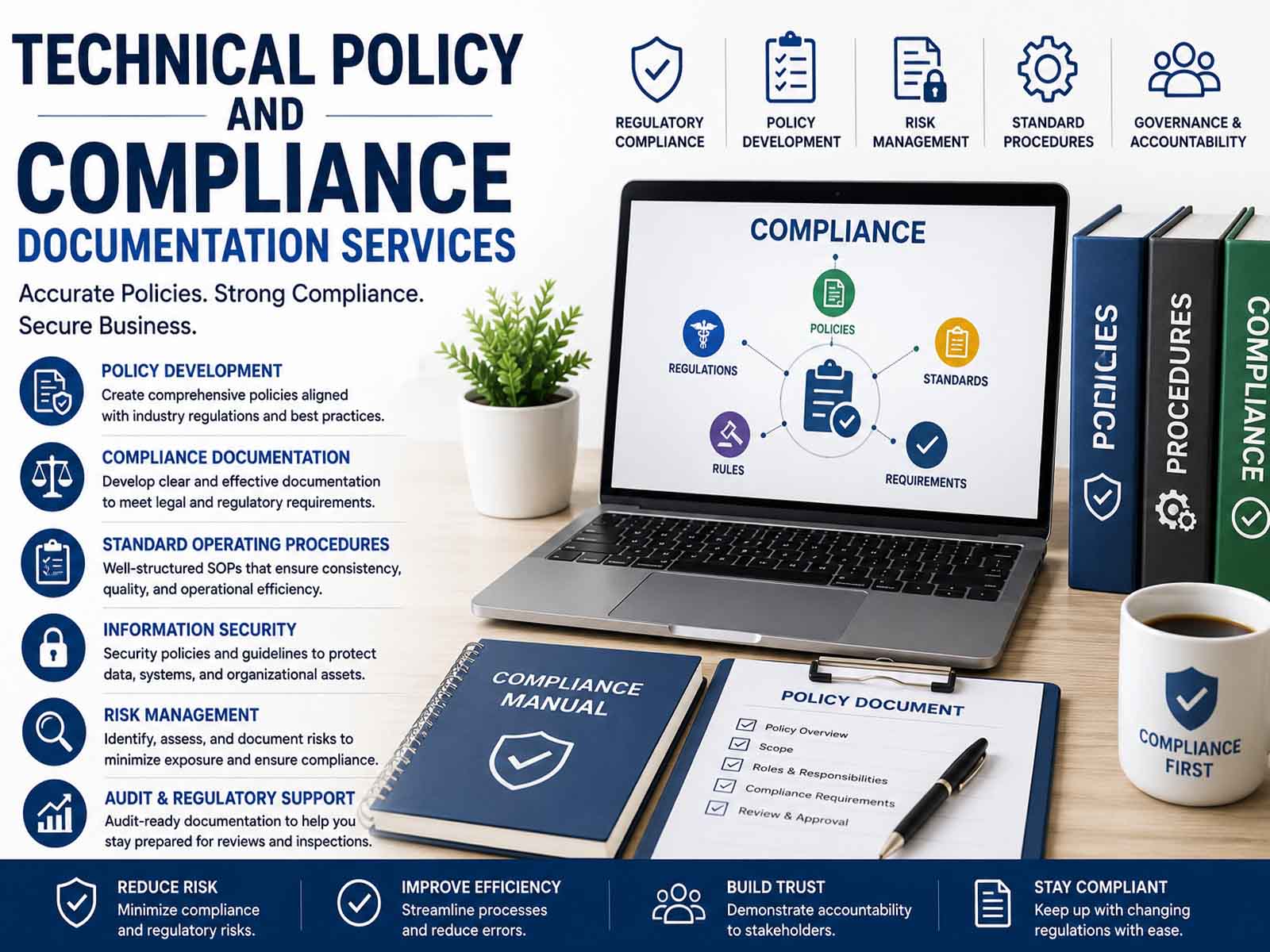
Technical Policy and Compliance Documentation Services
Every organization that operates within a regulated industry or handles sensitive information eventually faces the challenge of creating clear, accurate, and legally sound documentation that governs how its systems and processes function. Technical policy Technical Report Writing and Documentation Services and compliance documentation services exist to help businesses translate complex regulatory requirements and internal procedures into written materials that employees can actually understand and follow. These services combine technical expertise with regulatory knowledge to produce documents that protect organizations from legal risk while also supporting smooth daily operations. This article explores the importance of these services, the challenges they address, and the value they bring to businesses of all sizes, while naturally incorporating key concepts such as regulatory risk management, standard operating procedures, and information security governance, all of which sit at the heart of effective compliance documentation.
Why Organizations Need Structured Compliance Documentation ?
Many businesses underestimate how much of their daily operations depend on having clear, written policies in place. Without proper documentation, employees often rely on informal knowledge passed down through conversations, which leads to inconsistency and increases the risk of costly mistakes. Structured compliance documentation provides a single source of truth that defines exactly how processes should be carried out, what standards must be met, and who is responsible for specific tasks. This becomes especially important during audits, legal disputes, or regulatory reviews, when organizations must prove that they have taken reasonable steps to meet industry requirements. Without proper documentation, even a company that follows best practices internally may struggle to demonstrate compliance simply because nothing was ever written down in a clear, verifiable format.
Understanding the Difference Between Policy, Procedure, and Standard
A common source of confusion in compliance work comes from mixing up policies, procedures, and standards, even though each serves a distinct purpose. A policy typically expresses a high-level commitment or rule, such as a company's stance on data privacy or workplace safety. A procedure breaks that policy down into specific, actionable steps that employees must follow to remain compliant. A standard, meanwhile, defines measurable requirements, such as minimum password length or required encryption levels, that support both policies and procedures. Technical documentation services help organizations clearly separate these layers, ensuring that each document serves its intended purpose without becoming overly long, confusing, or duplicative. This separation also makes it easier to update individual components without rewriting entire policy frameworks whenever small operational details change.
Translating Regulatory Requirements into Practical Language
One of the most difficult aspects of compliance work involves translating dense legal and regulatory language into instructions that everyday employees can realistically follow. Regulations are often written by legal professionals using precise but Professional Business Process Documentation Services inaccessible terminology, which creates a gap between what the law requires and what staff members actually understand. Documentation specialists bridge this gap by carefully studying regulatory text and converting it into plain language policies and procedures that maintain legal accuracy while remaining practical for daily use. This translation process requires a strong understanding of both the regulatory framework and the operational realities of the business, since documentation that is technically correct but impossible to follow in practice provides little real protection against compliance failures.
Industry-Specific Compliance Challenges
Different industries face vastly different compliance requirements, which means documentation services must adapt their approach depending on the sector involved. Healthcare organizations must navigate patient privacy regulations and strict data handling rules, while financial institutions face requirements related to fraud prevention, reporting, and consumer protection. Technology companies often deal with data security regulations that vary by region, especially when serving international customers. Manufacturing businesses may need documentation focused on workplace safety and environmental standards. A skilled documentation service understands these industry-specific nuances and tailors its approach accordingly, rather than applying a generic template that fails to address the particular risks and obligations relevant to a specific business sector.
Information Security Policies and Data Protection Documentation
As cyber threats continue to grow in sophistication, information security governance has become one of the most critical areas of compliance documentation. Organizations need clear policies covering topics such as access control, data encryption, incident response, and acceptable use of company systems. These documents must strike a careful balance between being thorough enough to address genuine security risks and being practical enough for employees to actually follow in their daily work. Overly complex security policies often get ignored, while overly simplistic ones fail to provide meaningful protection. Documentation specialists work closely with technical teams to ensure that security policies accurately reflect actual system configurations and real-world threats, rather than existing as generic boilerplate that does not match the organization's true technical environment.
Standard Operating Procedures and Operational Consistency
Beyond high-level policies, organizations rely heavily on standard operating procedures to maintain consistency across daily operations. These documents provide step-by-step instructions for completing specific tasks, ensuring that work is performed the same way regardless of which employee is handling it. Well-written procedures reduce training time for new staff, minimize errors, and create a reliable record of how processes should function. Documentation services often work directly with subject matter experts within an organization to capture existing knowledge and convert it into clear, structured procedures. This process can be surprisingly revealing, as it often uncovers inconsistencies in how different employees currently perform the same task, highlighting areas where standardization is urgently needed.
Risk Assessment and Documentation Alignment
Effective compliance documentation does not exist in isolation; it must align closely with an organization's broader risk management strategy. Before writing policies and procedures, documentation specialists often begin with a thorough risk assessment to identify the areas where the organization faces the greatest exposure to legal, financial, or reputational harm. This assessment helps prioritize which documents need immediate attention and ensures that the most critical risks are addressed with the strongest, most detailed guidance. Regulatory risk management becomes far more effective when documentation is built around actual identified risks rather than generic assumptions about what regulators might expect, since this targeted approach ensures resources are spent where they matter most.
Version Control and Document Lifecycle Management
Compliance documentation is rarely a one-time project, since regulations change, business operations evolve, and new risks emerge over time. Proper version control becomes essential to ensure that employees always have access to the most current policies and procedures, while outdated versions are clearly archived rather than accidentally circulated. Documentation services often help organizations establish formal review cycles, ensuring that every policy is periodically reassessed for accuracy and relevance. This lifecycle management approach prevents the common problem of organizations operating under documentation that technically still exists but no longer reflects current regulatory requirements or actual business practices, which can create serious legal exposure during audits or investigations.
Training Materials and Employee Understanding
Even the most well-written policy provides little value if employees do not understand or remember its contents. Many documentation services extend their work beyond the core policy documents to include training materials, summaries, and quick reference guides that reinforce key compliance concepts in more digestible formats. This additional layer of communication helps bridge the gap between formal documentation and actual employee behavior, since people are far more likely to follow guidelines they genuinely understand rather than dense legal text they have never fully read. Effective training materials often use real-world scenarios and examples relevant to specific job roles, making abstract compliance requirements feel more concrete and applicable to daily responsibilities.
Supporting Audits and Regulatory Reviews
When regulatory bodies or internal auditors review an organization's compliance status, well-organized documentation can make the difference between a smooth review process and a stressful, drawn-out investigation. Auditors typically expect to see clear evidence that policies exist, have been properly communicated, and are actively followed within the Custom Technical Writing and Documentation Solutions organization. Documentation services help prepare businesses for these reviews by ensuring that all required policies are current, properly formatted, and supported by evidence such as training records or acknowledgment forms. This preparation significantly reduces the stress and uncertainty that often accompanies regulatory audits, since organizations can confidently demonstrate their compliance efforts rather than scrambling to produce missing or outdated documentation under pressure.
Customization Versus Template-Based Approaches
While templates can provide a useful starting point for compliance documentation, relying too heavily on generic templates often creates serious gaps in protection. Every organization has unique operational details, risk factors, and regulatory obligations that generic templates simply cannot address. Quality documentation services use templates as a foundation while heavily customizing the content to reflect the specific business context, technical infrastructure, and regulatory environment of each client. This balanced approach saves time compared to building documents entirely from scratch while still ensuring that the final product genuinely reflects the organization's actual practices and risks rather than offering only superficial compliance that might fail to hold up under closer scrutiny.
Collaboration Between Legal, Technical, and Operational Teams
Successful compliance documentation requires close collaboration between multiple departments within an organization. Legal teams understand regulatory obligations, technical teams understand system capabilities and limitations, and operational staff understand how work actually gets done on a daily basis. Documentation specialists often serve as a bridge between these groups, gathering input from each department and synthesizing it into coherent, accurate documents. This collaborative process helps prevent common problems such as policies that are legally sound but technically impossible to implement, or procedures that look good on paper but do not match how work actually happens within the organization's real operational environment.
Long-Term Benefits of Professional Documentation Services
Investing in professional technical policy and compliance documentation services delivers benefits that extend far beyond simply avoiding regulatory penalties. Well-documented organizations tend to experience smoother onboarding processes, fewer operational errors, and greater overall consistency in how work is performed across different teams and locations. Strong documentation also builds trust with customers, partners, and regulators, signaling that the organization takes its responsibilities seriously and operates with transparency. As regulations continue to evolve and become more complex across nearly every industry, organizations that maintain strong documentation practices position themselves to adapt more quickly and confidently to new requirements, rather than scrambling reactively each time rules change.
Conclusion
Technical policy and compliance documentation services play a vital role in helping organizations operate safely, consistently, and within legal boundaries. From translating complex regulations into practical language to maintaining standard operating procedures and supporting audit readiness, these services touch nearly every aspect of organizational governance. Regulatory risk management, standard operating procedures, and information security governance are deeply interconnected elements of a strong compliance framework rather than isolated concerns. Organizations that invest in professional, carefully tailored documentation not only reduce their legal and operational risks but also build a foundation of clarity and consistency that supports long-term organizational success across every level of their operations.
Comments